September 5th-December 21st
MONDAYS:
7-8:15 Multi-level, Lake Milo Boathouse
WEDNESDAYS:
5:30-6:45 Gentle Beginner, Lila Centre
THURSDAYS:
7-8:15 Intermediate-Advanced (Ashtanga Inspired), Figures
**Please call or email to register for this class
sheri.rempel@gmail.com or 648-4456
Tuesday, August 16, 2011

Friday, July 29, 2011
Ashtanga Classes with Sheri
Hi there, so I'll be covering Christie and Krissie's intermediate classes the week of August 8th. I will be offering an introduction to Ashtanga for the following three days:
Tuesday 7-8:15
Wednesday 7:15-8:30
Thursday 7-8:15
If you'd like to see what the primary series consists of- check out the following website.
Ashtanga Primary Series Postures
Hope to see you there!!
In light,
Sheri
Tuesday 7-8:15
Wednesday 7:15-8:30
Thursday 7-8:15
If you'd like to see what the primary series consists of- check out the following website.
Ashtanga Primary Series Postures
Hope to see you there!!
In light,
Sheri
Sunday, July 3, 2011
Inner Shakti Summer Session
Dates for Summer Yoga Session with Sheri – 2011
July
Mondays 4th, 11th, 25th (the boathouse is rented to someone else on the 18th – if I can find another venue I’ll let you know and we can have class on that day as well).
Wednesdays 6th, 13th, 20th, 27th
August
Mondays 8th, 15th, 22nd, 29th
Wednesdays 10th, 17th, 24th, 31st
***There will be no classes the first week of August***
Tuesday, June 28, 2011
Apple Cookie Recipe
1 cup margarine
1/2 cup brown sugar
1/2 cup white sugar
1 egg
1 tsp vanilla
2 cups flour
2 tsp baking powder
1/2 tsp baking soda
2-3 shredded apples
Cream sugar and margarine. Add in egg and vanilla - mix well. Add flour, powder and soda - mix. Add apples - mix. Place spoonfuls on cookie sheet. Sprinkle with cinnamon and sugar. Bake at 350 for 12-15 minutes.
Enjoy!!!!!
1/2 cup brown sugar
1/2 cup white sugar
1 egg
1 tsp vanilla
2 cups flour
2 tsp baking powder
1/2 tsp baking soda
2-3 shredded apples
Cream sugar and margarine. Add in egg and vanilla - mix well. Add flour, powder and soda - mix. Add apples - mix. Place spoonfuls on cookie sheet. Sprinkle with cinnamon and sugar. Bake at 350 for 12-15 minutes.
Enjoy!!!!!
Wednesday, June 1, 2011
Asteya - a quote by Laura Baker Cole
"Asteya is not stealing. It’s not looking outside of ourselves for things, other people or situations to bring happiness to us. It is not taking something that has not been given freely. Asteya is not looking at our lives and focusing on what we feel we lack, but enjoying the gifts we already have."
Sunday, May 29, 2011
On Satya- truth
So my computer skills aren't great- that's the truth lol. I couldn't figure out how to link the article so I just copied and pasted. This is an article from www.myyogaonline.com
For those of you in my Mondays class, it relates to the Yama we learned about last week- Satya. Enjoy:)
By Coming Soon • November 25th, 2010
 Yoga teachers trained in the West may receive an introduction to the yamas and the niyamas of yoga as part of Patanjalis eight limbs of yoga. If you are a yoga teacher, you may know of their existence and importance. If you are a student of yoga, you may find yourself wanting to become a more ethical person, simply through being present in yoga classes over a period of time. If you are starting out, you may have no idea what is being referred to here, but like all energetic interactions, one must experience it through ones actual practice, philosophical discussions aside. Many western teacher training schools, while they introduce this philosophy will braise over the philosophy of yoga and delve right into asana (postures), as this is what we are mainly teaching to students, though this too, is changing. Though an appropriate approach for most people wanting to learn how to be a yoga teacher, the yamas and niyamas are not first and second in the list of limbs randomly.
Yama, the first limb of yoga or ethical discipline, is similar to that of the great commandments, transcending creed, country, age and time. These rules of conduct, or yamas are: ahimsa (non-violence), satya (truth), asteya (non-stealing), brahmacharya (continence), and aparigraha (non-coveting). It is the lack of attention paid to the yamas that lead to mental and emotional suffering, and it is this suffering that turns many onto a yogic path, first via asana, and then through the practice of meditation, or control of the mind.
The Niyamas, to outline the difference, are rules that govern individual conduct, while the yamas are universal. There are five niyamas called: saucha (purity), santosha (contentment), tapas (austerity), svadhyaya (study of self) and isvara (dedication to the lord). For the sake of exemplification, let us use satya to make the connection from the mat to the yamas, and how we conduct ourselves in daily existence.
Satya, or truth, is the highest rule of conduct or morality. If the mind thinks truth, if the tongue speaks truth and if one's life is based on truth, the person becomes fit for the union with the infinite, which really, is yoga's ultimate path (as opposed to increased flexibility!) Truth is not limited to speech alone. There are four sins of speech: abuse and obscenity, dealing in falsehoods, telling tales and ridiculing others. The ancient Chinese proverb, "he who controls his tongue has attained self control in a great measure" comes to mind when speaking of satya and how we live it. When attempting to live a life without falsehoods satya seems to be almost non-existent due to the many masks we wear when doing business, in our personal affairs, or even when existing among our own family members. The truth can be only found within an individual.
To live a life with truth is to live to its ultimate peak. It may be easy for a person to believe or justify that they are living with integrity by coming to yoga classes, but it goes much further than the physical practice. A life lived with truth, when no one is watching, creates ripples of positive actions, which in return leads to positive karma, which in turn reduces mental and emotional stress. Many times, a lie, even one not meant with malice causes anxiety to us, as we wonder why we said we would do something when we really had no intention of doing it. Perhaps we have exaggerated a skill on a resume and then fear that the interviewer will check on this fact by asking us, causing us to extend the truth or the lie, or that a reference will be called and we worry about what that person will say about the exaggeration on the resume. With even greater subtlety someone may withhold information or feelings on what they really want from their partner for fear of rejection, ridicule, or guilt due to societal conditioning. Think of a time where you wanted to be held, to make love, or have your partner know a secret you would not want to share.
Withholding can also be considered an untruth. Once the body has become so open through yoga practice, the chakras in the body also open wider, allowing us to speak with more confidence, clarity and our true intentions. Speaking and acting with satya can then open a couple to true intimacy through communication, and we all know that communication is key for success in relating not only to our partners, but to all beings. The truth is that we are here as a spirit, in human form, trying to release ourselves from the wheel of samsara or suffering. The ancient yogic scriptures speak of truth and give us practical methods to release the hold of human desires. All we have to do is to experiment with their methods and observe the results. Try a day of saying exactly what you mean, politeness aside, and asking also for what you want, exactly for what you want. Also practice the art of being who you really are, which is not someone who does things they do not really want to do. Observe the results. Repeat.
About the author:
Satyama Lasby is a hatha yoga instructor with over 10 years experience teaching in Canada, India and Guatemala. Certified in Integrative Yoga Therapy, her influences come from Sivanada and Agama Yoga studied in Kerala and Rishikesh respectively. Satyama worked and taught at the Osho International Meditation Resort in 2009 where active meditations and level of interpersonal relating changed her entire outlook and approach to work and life. She loves to serve, dance, teach and touch. Currently residing in Whistler, Satyama's dharma is to bring meditation to people's lives. She works to manage a yoga wear company called FRUV Freedomwear. She intuitively paints kundalini energy spirals, rides her bike and makes students smile. "It starts on the mat, but it real bliss occurs when your yoga and meditation become connected to every spontaneous moment."
For those of you in my Mondays class, it relates to the Yama we learned about last week- Satya. Enjoy:)
By Coming Soon • November 25th, 2010
Yama, the first limb of yoga or ethical discipline, is similar to that of the great commandments, transcending creed, country, age and time. These rules of conduct, or yamas are: ahimsa (non-violence), satya (truth), asteya (non-stealing), brahmacharya (continence), and aparigraha (non-coveting). It is the lack of attention paid to the yamas that lead to mental and emotional suffering, and it is this suffering that turns many onto a yogic path, first via asana, and then through the practice of meditation, or control of the mind.
The Niyamas, to outline the difference, are rules that govern individual conduct, while the yamas are universal. There are five niyamas called: saucha (purity), santosha (contentment), tapas (austerity), svadhyaya (study of self) and isvara (dedication to the lord). For the sake of exemplification, let us use satya to make the connection from the mat to the yamas, and how we conduct ourselves in daily existence.
Satya, or truth, is the highest rule of conduct or morality. If the mind thinks truth, if the tongue speaks truth and if one's life is based on truth, the person becomes fit for the union with the infinite, which really, is yoga's ultimate path (as opposed to increased flexibility!) Truth is not limited to speech alone. There are four sins of speech: abuse and obscenity, dealing in falsehoods, telling tales and ridiculing others. The ancient Chinese proverb, "he who controls his tongue has attained self control in a great measure" comes to mind when speaking of satya and how we live it. When attempting to live a life without falsehoods satya seems to be almost non-existent due to the many masks we wear when doing business, in our personal affairs, or even when existing among our own family members. The truth can be only found within an individual.
To live a life with truth is to live to its ultimate peak. It may be easy for a person to believe or justify that they are living with integrity by coming to yoga classes, but it goes much further than the physical practice. A life lived with truth, when no one is watching, creates ripples of positive actions, which in return leads to positive karma, which in turn reduces mental and emotional stress. Many times, a lie, even one not meant with malice causes anxiety to us, as we wonder why we said we would do something when we really had no intention of doing it. Perhaps we have exaggerated a skill on a resume and then fear that the interviewer will check on this fact by asking us, causing us to extend the truth or the lie, or that a reference will be called and we worry about what that person will say about the exaggeration on the resume. With even greater subtlety someone may withhold information or feelings on what they really want from their partner for fear of rejection, ridicule, or guilt due to societal conditioning. Think of a time where you wanted to be held, to make love, or have your partner know a secret you would not want to share.
Withholding can also be considered an untruth. Once the body has become so open through yoga practice, the chakras in the body also open wider, allowing us to speak with more confidence, clarity and our true intentions. Speaking and acting with satya can then open a couple to true intimacy through communication, and we all know that communication is key for success in relating not only to our partners, but to all beings. The truth is that we are here as a spirit, in human form, trying to release ourselves from the wheel of samsara or suffering. The ancient yogic scriptures speak of truth and give us practical methods to release the hold of human desires. All we have to do is to experiment with their methods and observe the results. Try a day of saying exactly what you mean, politeness aside, and asking also for what you want, exactly for what you want. Also practice the art of being who you really are, which is not someone who does things they do not really want to do. Observe the results. Repeat.
About the author:
Satyama Lasby is a hatha yoga instructor with over 10 years experience teaching in Canada, India and Guatemala. Certified in Integrative Yoga Therapy, her influences come from Sivanada and Agama Yoga studied in Kerala and Rishikesh respectively. Satyama worked and taught at the Osho International Meditation Resort in 2009 where active meditations and level of interpersonal relating changed her entire outlook and approach to work and life. She loves to serve, dance, teach and touch. Currently residing in Whistler, Satyama's dharma is to bring meditation to people's lives. She works to manage a yoga wear company called FRUV Freedomwear. She intuitively paints kundalini energy spirals, rides her bike and makes students smile. "It starts on the mat, but it real bliss occurs when your yoga and meditation become connected to every spontaneous moment."
Current Yoga Schedule

Mon - 7-8:15
Multi-level
Lake Milo Boathouse
Wed - 5:30-6:45
Gentle Beginner
Lila Center
Thur- 5-6
Multi-level
YMCA
Thursday, May 12, 2011
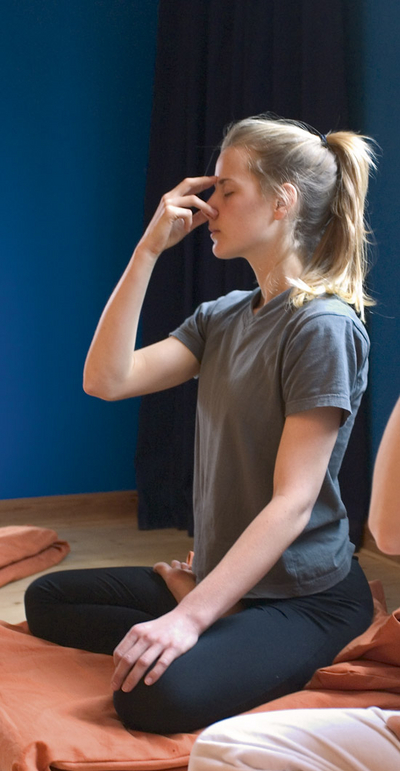
Benefits of Alternate Nostril Breathing by Carole Fogarty
1: Revitalizes you:
A few rounds of alternate nostril breathing is a quick pick me up if you are feeling flat, tired or even stressed. It provides your body with a much needed dose of extra energy.
Alternate nostril breathing is a simple little trick that can be practiced for a few minutes before you begin your meditation practice. It’s a very easy way to help you find your meditation groove.
9: Soothes your nervous system:
By focusing on your breath and deepening it, your brain will register this message and trigger the parasympathetic nervous system. You have effectively switched your nervous system from a stressed response, into a relaxation response. Single left nostril breathing (by closing your right nostril) will direct the flow of oxygen and energy to the right hemisphere of your brain, allowing once again, for the parasympathetic nervous system to be switched on. Gosh, your breath and nose is very clever.
10: Regulates the cooling and warming cycles of the body:
Left nostril is feminine, nurturing, calm and cooling. Right nostril is masculine, heat, competitive and force. Favouring one nostril more than the other can effect the heat or coolness of your body.
11: Clears and boosts your energy channels:
Slightly forced alternate nostril breathing improves and directs the flow of energy throughout your body – preventing sluggishness. It oxygenates your blood and allows the energy (prana) in your body to be strong and flowing.
12: Enhances rest and relaxation:
A restless mind cannot relax. Alternate nostril breathing melts away an imbalances between the right and left hemisphere of your brain and calms your thinking. This is perfect for helping you access rest and relaxation far more efficiently.
A few rounds of alternate nostril breathing is a quick pick me up if you are feeling flat, tired or even stressed. It provides your body with a much needed dose of extra energy.
2: Improves brain function:
When you mind is dull – concentration and clarity is poor. Alternate nostril breathing brings equal amounts of oxygen to both sides of the brain for improved brain function. Five minutes of alternate nostril breathing before an exam or interview is a great way to access your whole brain for improved performance.
3: Cleanses your lungs:
A daily five minute practice morning and night of alternate nostril breathing is great way to remove stale air and impurities from the bottom of your lungs.
It wasn’t until I started reading the The Tao of Natural Breathing by Dennis Lewis that I discovered something I did not know. 70% of our body’s waste products are eliminated via our lungs.
4: Calms an agitated mind:
I’m prone to worrying. A few minutes of focused alternate nostril breathing is helpful (for me) in calming my “over thinking” mind. The ancient yogis believe that if you can regulate your breath, then you can control your mind.
5: Merges the left “thinking” brain and right “feeling brain:
Alternate nostril breathing optimizes both sides of your brain so you can access your whole brain, and all the benefits that go with it.
The flip side of course is, single nostril breathing can be used to activate, just the left”thinking” or just right “feeling” side of your brain for specific situations.
Try it out next time you need to drive your car. Cover your left nostril with your thumb and breathe only through your right nostril for one minute. This should keep you more alert when driving.
6: Encourage a calmer emotional state:
In times of emotional distress and upset, a few rounds of mindful nostril breathing will soften the intensity of over reactive emotional states. The longer you practice, the more stable your thinking, and the calmer your emotions will become.
7: Improves sleep:
If you can’t sleep at night lay on your right hand side, gently close your right nostril with your right thumb and breath through your left nostril. This will activate your parasympathetic nervous system which will calm you down and slow your heart rate.
8: Great preparation for meditation:Alternate nostril breathing is a simple little trick that can be practiced for a few minutes before you begin your meditation practice. It’s a very easy way to help you find your meditation groove.
9: Soothes your nervous system:
By focusing on your breath and deepening it, your brain will register this message and trigger the parasympathetic nervous system. You have effectively switched your nervous system from a stressed response, into a relaxation response. Single left nostril breathing (by closing your right nostril) will direct the flow of oxygen and energy to the right hemisphere of your brain, allowing once again, for the parasympathetic nervous system to be switched on. Gosh, your breath and nose is very clever.
10: Regulates the cooling and warming cycles of the body:
Left nostril is feminine, nurturing, calm and cooling. Right nostril is masculine, heat, competitive and force. Favouring one nostril more than the other can effect the heat or coolness of your body.
11: Clears and boosts your energy channels:
Slightly forced alternate nostril breathing improves and directs the flow of energy throughout your body – preventing sluggishness. It oxygenates your blood and allows the energy (prana) in your body to be strong and flowing.
12: Enhances rest and relaxation:
A restless mind cannot relax. Alternate nostril breathing melts away an imbalances between the right and left hemisphere of your brain and calms your thinking. This is perfect for helping you access rest and relaxation far more efficiently.
Tuesday, May 3, 2011
Why do we always turn to the right side before sitting up after savasana?
Monday, May 2, 2011
Why do we always start with the right side first when we practice our asana?

The concept of polarity, or balancing the opposites, is vital to both yoga and Indian traditional life. The right side of the body is related to the solar/positive/masculine flows of energy that are manifest by the surya nadi, which is correlated to the termination of the pingala nadi (a major prana nadi which flows along the right side of the spine.)
Similarly, the left side is related to the lunar/negative/feminine flows of energy that are manifest by the chandra nadi, which may be said to be the termination of the ida nadi (along the left side of the spine).
Indian customs demonstrate that all daily activities are started on the right side, because the right side is considered to be auspicious. If an Indian were given an offering by the left hand, he or she would consider it an insult and refuse it! Similarly, receiving anything with the left hand is totally out of the question!
Also, when we enter the premises of a newly constructed building, for instance, we always use the right leg first, just as in the saying “put your best foot forward”.
All of this points to the answer to your question, which is to start on the right and then make sure you follow it with the left for proper yoga balance.
In spinal twists, the turn is always clockwise first, as the concept of pradakshina or circumbulation around Hindu temples is always clockwise. It is interesting to note that the Hindu swastika turns clockwise, whereas Hitler’s swastika turns counter-clockwise. Speak of opposite energies bringing about opposite effects!
Yogamaharishi Dr. Swami Gitananda Giri also always taught us that the energy in the chakras moves in a clockwise direction. If you take ten traditional Indians and ask them to turn around, they will likely all turn in the clockwise direction. For proper yoga balance, twists are thus done first to the right, then to the left.
Regarding the forward and back bending asanas, when we bend forward we stimulate the solar plexus, and so this is termed the loma, or positive action. When we bend backward, we relax the solar plexus, and this is termed the viloma, or negative action. In practice it is therefore better to do forward bends before back bends if we want to follow this polarity yoga balance concept.
Some interesting research in at Svyasa in Bangalore , South India , showed that relaxation practices done following strenuous activity provided greater benefit than the pure relaxation practices done alone. Viewed from the standpoint of right and left, if we do the right, or active, side first, then we may benefit more from the practice by ending with the left. This will lead to a state of yoga balance (of steadiness, relaxation).
On the contrary, if we do the left, or passive, side first, then we may end up stimulated (hyper-energetic, imbalanced). As yoga is the science of balance, performance on the right side before the left side may help us to maintain homeostasis (samatvam).
We must also remember that even the term Hatha Yoga, which means “sun and moon,” has the right side placed before the left in its esoteric association of ha with the sun and tha with the moon (Hatha).
With regard to the common question of how to tell whether one is doing the left side or the right side in standing poses, I would say that the side that bears the maximum weight of the body in the pose is the side one is doing. For instance, many students get confused when they first stand in natarajasana on the right leg with the left arm and foot raised behind the back, thinking that they are doing the left side because both the left arm and leg are being used, whereas they are actually doing the right.
Of course, all of the above discussion applies to normal, balanced individuals, of whom very few seem to practice modern yoga. In cases where stimulation is required, as in patients with depression, excessive sleepiness or drowsiness, and so on, then right after left may be preferable.
Wednesday, April 20, 2011
When your yoga teacher doesn't have the same schedule as you.....
Since I'm on a role, I'll add one more quick post for the day. Here's a couple of really great websites jam packed full of online classes that you can watch anytime:)
http://www.yogaglo.com/
http://www.myyogaonline.com/
The best part about both of these is that you get a free trial membership and if you choose to stick with the membership- it's not super expensive and you always have a wide variety of classes, teachers and class durations to choose from.
Happy Yoga!
Om Shanti
http://www.yogaglo.com/
http://www.myyogaonline.com/
The best part about both of these is that you get a free trial membership and if you choose to stick with the membership- it's not super expensive and you always have a wide variety of classes, teachers and class durations to choose from.
Happy Yoga!
Om Shanti
Clearly I'm not very good at this lol
So, it seems that I'm not very good at the whole blogging thing. I really like the idea and think about it alot - but it seems that whenever I have a really great idea, my computer is nowhere to be found. I've since added the app on my phone in the hope that when those moments of inspiration hit me, that I can perhaps share them with whomever chooses to listen. That being said I do have several things to share. One being that the Atlantic Yoga Conference was FANTASTIC! Really great speakers and presenters. Michael Stone is amazing - he has a really honest way of applying to teachings of yoga to our everchanging, ultra fast paced, smart phone armed, multitasking world that is so far removed from life as it were when the teachings were written. This is great...really, because if you'd ever read the Yoga-Sutras you'll have often wondered to yourself, how you'd ever be able to apply half of what it says and still manage to lead some sort of yogic life... re: brahmacharya lol. Grace Jull taught me that our arms are extentions of our hearts....literall. Barrie Risman taught me that our shoulders really are our wings that allow us to fly - unfettered to our long held preconceptions about what we can and cannot do.
So, this all being said - I'm determined to do better, to share and to let go a little more. We'll see what happens:)
So, this all being said - I'm determined to do better, to share and to let go a little more. We'll see what happens:)
Thursday, February 10, 2011
How Meditation May Change the Brain
How Meditation May Change the Brain
By SINDYA N. BHANOO Getty Images
 He said the experience was so transformational that he has committed to meditating for two hours daily, one hour in the morning and one in the evening, until the end of March. He’s running an experiment to determine whether and how meditation actually improves the quality of his life.
I’ll admit I’m a skeptic.
But now, scientists say that meditators like my husband may be benefiting from changes in their brains. The researchers report that those who meditated for about 30 minutes a day for eight weeks had measurable changes in gray-matter density in parts of the brain associated with memory, sense of self, empathy and stress. The findings will appear in the Jan. 30 issue of Psychiatry Research: Neuroimaging.
M.R.I. brain scans taken before and after the participants’ meditation regimen found increased gray matter in the hippocampus, an area important for learning and memory. The images also showed a reduction of gray matter in the amygdala, a region connected to anxiety and stress. A control group that did not practice meditation showed no such changes.
But how exactly did these study volunteers, all seeking stress reduction in their lives but new to the practice, meditate? So many people talk about meditating these days. Within four miles of our Bay Area home, there are at least six centers that offer some type of meditation class, and I often hear phrases like, “So how was your sit today?”
Britta Hölzel, a psychologist at Massachusetts General Hospital and Harvard Medical School and the study’s lead author, said the participants practiced mindfulness meditation, a form of meditation that was introduced in the United States in the late 1970s. It traces its roots to the same ancient Buddhist techniques that my husband follows.
“The main idea is to use different objects to focus one’s attention, and it could be a focus on sensations of breathing, or emotions or thoughts, or observing any type of body sensations,” she said. “But it’s about bringing the mind back to the here and now, as opposed to letting the mind drift.”
Generally the meditators are seated upright on a chair or the floor and in silence, although sometimes there might be a guide leading a session, Dr. Hölzel said.
Of course, it’s important to remember that the human brain is complicated. Understanding what the increased density of gray matter really means is still, well, a gray area.
“The field is very, very young, and we don’t really know enough about it yet,” Dr. Hölzel said. “I would say these are still quite preliminary findings. We see that there is something there, but we have to replicate these findings and find out what they really mean.”
It has been hard to pinpoint the benefits of meditation, but a 2009 study suggests that meditation may reduce blood pressure in patients with coronary heart disease. And a 2007 study found that meditators have longer attention spans.
Previous studies have also shown that there are structural differences between the brains of meditators and those who don’t meditate, although this new study is the first to document changes in gray matter over time through meditation.
Ultimately, Dr. Hölzel said she and her colleagues would like to demonstrate how meditation results in definitive improvements in people’s lives.
“A lot of studies find that it increases well-being, improves quality of life, but it’s always hard to determine how you can objectively test that,” she said. “Relatively little is known about the brain and the psychological mechanisms about how this is being done.”
In a 2008 study published in the journal PloS One, researchers found that when meditators heard the sounds of people suffering, they had stronger activation levels in their temporal parietal junctures, a part of the brain tied to empathy, than people who did not meditate.
“They may be more willing to help when someone suffers, and act more compassionately,” Dr. Hölzel said.
Further study is needed, but that bodes well for me.
For now, I’m more than happy to support my husband’s little experiment, despite the fact that he now rises at 5 a.m. and is exhausted by 10 at night.
An empathetic husband who takes out the trash and puts gas in the car because he knows I don’t like to — I’ll take that.
Sunday, February 6, 2011
Pose of the Week
Here's an extra one because I've missed out for a couple of weeks.
Half Lord of the Fishes
 Sit on the floor with your legs straight out in front of you. Bend your knees, put your feet on the floor, then slide your left foot under your right leg to the outside of your right hip. Lay the outside of the left leg on the floor. Step the right foot over the left leg and stand it on the floor outside your left hip. The right knee will point directly up at the ceiling.
 Exhale and twist toward the inside of the right thigh. Press the right hand against the floor just behind your right buttock, and set your left upper arm on the outside of your right thigh near the knee. Pull your front torso and inner right thigh snugly together.
 Press the inner right foot very actively into the floor, release the right groin, and lengthen the front torso. Lean the upper torso back slightly, against the shoulder blades, and continue to lengthen the tailbone into the floor.
 You can turn your head in one of two directions: Continue the twist of the torso by turning it to the right; or counter the twist of the torso by turning it left and looking over the left shoulder at the right foot.
 With every inhalation lift a little more through the sternum, pushing the fingers against the floor to help. Twist a little more with every exhalation. Be sure to distribute the twist evenly throughout the entire length of the spine; don't concentrate it in the lower back. Stay for 30 seconds to 1 minute, then release with an exhalation, return to the starting position, and repeat to the left for the same length of time.
Half Lord of the Fishes

 Sit on the floor with your legs straight out in front of you. Bend your knees, put your feet on the floor, then slide your left foot under your right leg to the outside of your right hip. Lay the outside of the left leg on the floor. Step the right foot over the left leg and stand it on the floor outside your left hip. The right knee will point directly up at the ceiling. Exhale and twist toward the inside of the right thigh. Press the right hand against the floor just behind your right buttock, and set your left upper arm on the outside of your right thigh near the knee. Pull your front torso and inner right thigh snugly together. Press the inner right foot very actively into the floor, release the right groin, and lengthen the front torso. Lean the upper torso back slightly, against the shoulder blades, and continue to lengthen the tailbone into the floor. You can turn your head in one of two directions: Continue the twist of the torso by turning it to the right; or counter the twist of the torso by turning it left and looking over the left shoulder at the right foot. With every inhalation lift a little more through the sternum, pushing the fingers against the floor to help. Twist a little more with every exhalation. Be sure to distribute the twist evenly throughout the entire length of the spine; don't concentrate it in the lower back. Stay for 30 seconds to 1 minute, then release with an exhalation, return to the starting position, and repeat to the left for the same length of time.
 Pose of the Week
Warrior II
Virabhadrasa II

Stand in Tadasana. With an exhalation, step or lightly jump your feet 3 1/2 to 4 feet apart. Raise your arms parallel to the floor and reach them actively out to the sides, shoulder blades wide, palms down.
Turn your right foot in slightly to the right and your left foot out to the left 90 degrees. Align the left heel with the right heel. Firm your thighs and turn your left thigh outward so that the center of the left knee cap is in line with the center of the left ankle.
Exhale and bend your left knee over the left ankle, so that the shin is perpendicular to the floor. If possible, bring the left thigh parallel to the floor. Anchor this movement of the left knee by strengthening the right leg and pressing the outer right heel firmly to the floor.
Stretch the arms away from the space between the shoulder blades, parallel to the floor. Don't lean the torso over the left thigh: Keep the sides of the torso equally long and the shoulders directly over the pelvis. Press the tailbone slightly toward the pubis. Turn the head to the left and look out over the fingers.
Virabhadrasa II
Stand in Tadasana. With an exhalation, step or lightly jump your feet 3 1/2 to 4 feet apart. Raise your arms parallel to the floor and reach them actively out to the sides, shoulder blades wide, palms down. Turn your right foot in slightly to the right and your left foot out to the left 90 degrees. Align the left heel with the right heel. Firm your thighs and turn your left thigh outward so that the center of the left knee cap is in line with the center of the left ankle. Exhale and bend your left knee over the left ankle, so that the shin is perpendicular to the floor. If possible, bring the left thigh parallel to the floor. Anchor this movement of the left knee by strengthening the right leg and pressing the outer right heel firmly to the floor. Stretch the arms away from the space between the shoulder blades, parallel to the floor. Don't lean the torso over the left thigh: Keep the sides of the torso equally long and the shoulders directly over the pelvis. Press the tailbone slightly toward the pubis. Turn the head to the left and look out over the fingers. Tuesday, January 11, 2011
Pose of the Week
Balasana
Childs Pose
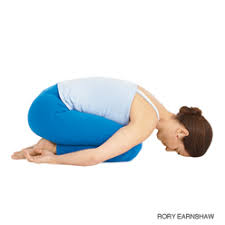
This is a great asana to take during a practice when you need to take time to regroup or as a stand-alone posture to help open the hips, stretch out the fronts of the thighs and the ankles. You can keep your knees together and take them apart. Arms can be at your sides or stretched out in front of you. Be sure to press the hips down towards the heels. Stay in this posture anywhere from 30 seconds to a few minutes. Listen to your body and let it tell you what it needs. Below is a link for a quick video of this asana:
http://video.aol.com/aolvideo/aol-living/yoga-pose-childs-pose/85261324001
Namaste
Childs Pose
This is a great asana to take during a practice when you need to take time to regroup or as a stand-alone posture to help open the hips, stretch out the fronts of the thighs and the ankles. You can keep your knees together and take them apart. Arms can be at your sides or stretched out in front of you. Be sure to press the hips down towards the heels. Stay in this posture anywhere from 30 seconds to a few minutes. Listen to your body and let it tell you what it needs. Below is a link for a quick video of this asana:
http://video.aol.com/aolvideo/aol-living/yoga-pose-childs-pose/85261324001
Namaste
Wednesday, January 5, 2011
Yoga Journal 21 day Challenge
New Year, New You
Have you ever tried to start a home practice but couldn't stick with it? Well, we have the solution! In our 21-Day Yoga Challenge, which starts on Jan. 10, you'll receive all the help you need to create a home yoga practice that works for your life. No matter how much time you have or how you feel on any given day, it's still possible to practice yoga and reap the benefits.How does it work? Each day, we'll present original videos of yoga sequences. There are 15-minute videos for morning and night; 30-minute videos to help refine your poses, work your core, and develop strength; and a super fun 45-minute flow sequence that'll have you moving all around your mat and getting a great workout in the process. By the end of the challenge, you'll have an arsenal of practices at your disposal to use whenever and however you want.
You'll also be able to listen to mediation and pranayama exercises, thanks to our friends at Sounds True. And you can blog about your experience on our Challenge Chat page. Finally, our Challenge newsletter will give you a little nudge each day, with background information about that day's video sequence, practice tips, and healthy and delicious recipes from Vegetarian Times.
How do you join in? Just sign up here with your email address, and on Jan. 10 you'll receive your first newsletter and a link to the first video and the 21-Day Yoga Challenge website. That's it! It's free and it's just for you.
What are you waiting for? Take the challenge!
http://21daychallenge.yogajournal.com/
All you have to do is submit your email address and start receiving the daily emails!!!
Subscribe to:
Posts (Atom)